Is one day enough for Hakone? The ropeway closes at 16:45
Count backwards from the last car
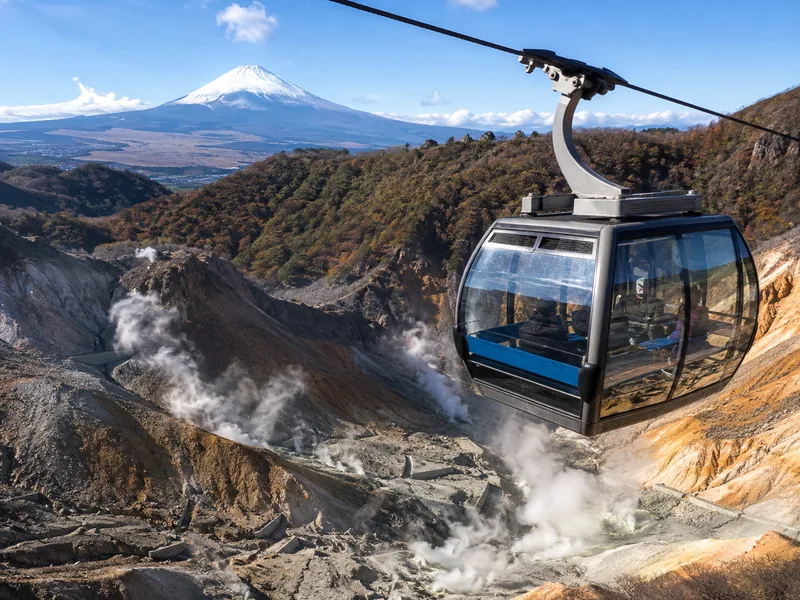
Work out the day in the order it actually happens and it stops being a question of taste. The last ropeway car goes at 16:45. Before that you want time at Owakudani, which is the stop nobody wants to cut short. Before that is the cable car up from Gora. Before that is about 35 minutes of Tozan railway from Hakone-Yumoto to Gora. And before all of it is 75 to 90 minutes from Shinjuku on the Romancecar, or about two hours on an ordinary Odakyu train with a change at Odawara.
Add it up and roughly two hours of your day is spent getting into Hakone, and the same again getting out. If you are not moving out of Shinjuku by about eight in the morning, you are not planning a day in Hakone, you are choosing which leg to drop. That is the whole answer. The route options and their fares are on Tokyo to Hakone.
The loop runs in both directions and the ropeway is the timed part either way. Starting from the lake end rather than the Gora end does not buy you more hours; it only changes which leg you are rushing at four o’clock.
What one day genuinely holds
One circuit, in one direction, with real time at two or three of the stops. That means the switchback train, the cable car, the ropeway over the vents at Owakudani, the boat across Lake Ashi and the torii standing in the water at Motohakone. It is a full day and it does not feel thin. What the legs are and how they connect is on the Hakone Loop page.
What it does not hold
The loop plus an onsen afternoon. The loop plus museums. The loop in both directions. Any plan that has you arriving in Hakone after lunch. And any plan that assumes you can go back for the ropeway tomorrow, because on a day trip there is no tomorrow — which is exactly the case for staying the night instead.
Two things that eat the day without warning
Weather. The ropeway suspends in high wind and the cruise reroutes or stops in heavy fog or strong wind. Both have happened to our own reviewers. Fares, seasonal hours and the wind problem are covered on the ropeway page, and live status is at hakonenavi.jp.
Traffic, if you are on a coach. The tours leave Tokyo between 7:30 and 8:00 precisely because of this, and it still bites. Giampaolo, who took the all-inclusive bullet-train tour, wrote: “Too bad there was so much traffic that we missed the cable car experience.” Delfin, on the most-booked ropeway tour, wrote: “Tokyo traffic pushed back the schedule and made it a long day.” A coach buys you the early start and hands back the risk in a different currency.
So: one day, or two?
One day works, on the condition that you start it properly and ride the circuit rather than sampling it. Two days is a different trip rather than a longer one: it is what you buy if you want an evening in Hakone, a second chance at the ropeway if the wind is up, and no arithmetic about last runs. There is a quiet nudge in that direction built into the pass, since the shortest Hakone Freepass is two days.
Frequently asked questions
How many hours do you need in Hakone?
Plan on a full day: about two hours in from Tokyo, five or six hours for the loop itself, and two hours back. The binding constraint is the ropeway’s last run at 16:45, or 16:15 in December and January, so the useful part of your day ends earlier than you would expect. An hour-by-hour version is on the one-day itinerary.
Can you do the whole Hakone Loop in one day?
Yes, in one direction, if you are on an early train out of Shinjuku. The Romancecar takes 75 to 90 minutes to Hakone-Yumoto and the Tozan train up to Gora takes about 35 more, which puts you at the ropeway with the afternoon still intact. Doing the loop twice, or adding an onsen, does not fit.
Is the Hakone Freepass worth buying for a single day?
There is no one-day version to buy — the shortest Hakone Freepass is two days at ¥7,100, so a day-tripper is paying for validity they will not use. On individual tickets one full loop comes to roughly ¥6,700 counting only the legs we could price, and two legs are unpriced, so it is close. The arithmetic is on the Freepass page.